NewtonNet

NewtonNet - HOME  Internet-Enabled Automatic Cat Feeder  House Renovation  Worcester Bosch 24CDi Repairs  Hyundai Coupe - Service Manuals etc  NewtonNet IPv6
NewtonNet Guestbook  Contact Me  NewtonNet Server Logs  NewtonNet Secure (HTTPS/SSL)  NewtonNet Mail (HTTPS/SSL) - Authorised Users Only

Page last modified Monday, 15-Feb-2010 21:29:06 GMT

 
NewtonNet is IPv6-enabled!

... but unfortunately you are not!

Happy

This assumption is based on the fact that you appear to be coming from 38.107.191.85 - an IPv4 address.
(this could actually be the address of a web-proxy you are using, knowingly or otherwise, however the end result is still the same)

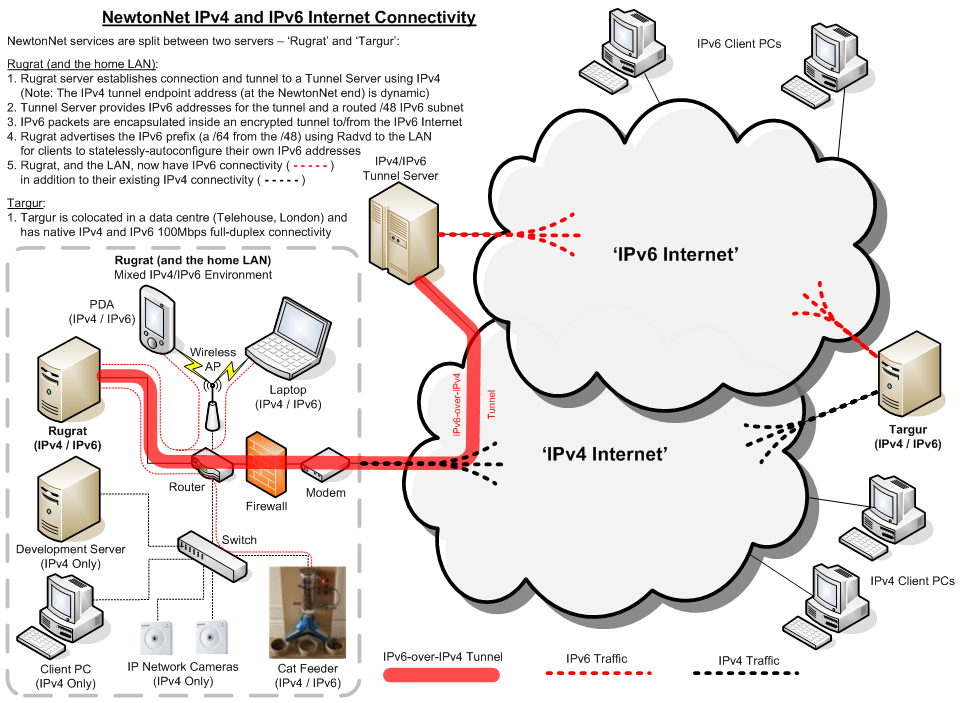
The NewtonNet server, Rugrat, sits in my house on the end of a 10Mbps (512kbps upload) residential cable broadband connection provided by Virgin Media. Unfortunately they only provide native IPv4 connectivity and so in order to have NewtonNet accessible via IPv6 I am having to tunnel IPv6 inside IPv4.

Whilst this all sounds wonderfully simple, the reality is rather more complex...

I am using the services and software from SixXS - an IPv6 Tunnel Broker project based in Switzerland. They have written a utility called AICCU (Automatic IPv6 Connectivity Client Utility) which automatically configures tunnels using TIC (Tunnel Information & Control Protocol) between end-users and an IPv6 Tunner Server, otherwise known as a PoP (Point of Presence). For performance reasons, I tunnel my IPv6 traffic to a PoP in London operated by Goscomb Technologies. The PoP has connections to what you might term the 'IPv4 Internet' and 'IPv6 Internet' and hence is able to pass traffic between the two.

The tunnelling method itself can take on one of many forms, however given my circumstances of using private (RFC1918) IP addresses behind a NAT gateway to a single dynamic public IP address I am using the AYIYA (Anything In Anything) protocol to create an IPv6-in-IPv4 tunnel - this basically wraps ups my IPv6 packets as the payload inside UDP running over IPv4. You can read the Internet-Draft describing exactly how it does this here.

In addition to providing the IPv6 addresses for the tunnel, the Goscomb PoP also routes a /48 prefix to my tunnel endpoint this giving me plenty of IPv6 addresses to play with, 1.20892582 x 1024 (1.2 septillion) to be exact!

Once the tunnel is established, my server then announces a /64 prefix to the NewtonNet LAN using the Router Advertisement Daemon (radvd) thus allowing IPv6-enabled clients to create their own globally-unique addresses using stateless autoconfiguration. The server also forwards IPv6 packets to/from the Internet on behalf of the local IPv6-enabled clients.

Told you it was a bit complicated! They do however say a picture speaks a thousand words so here goes...

NewtonNet IPv6 Connectivity

All clear now ?! ;-)

(Incidentally, yes, that is an IPv6-enabled Cat Feeder - see here for further details!)

Tunnel Statistics

The following graphs show various usage and performance indicators for my IPv6 tunnel and hence are useful, to me at least, to illustrate the health of the connection and how much traffic is being carried by IPv6. The latter measure is of particular interest as it should generally reflect the adoption of IPv6 across the Internet.


IPv6 Throughput - The following graphs show the average IPv6 throughput both for the last week and since the tunnel was established in March 2008. Such traffic includes my own browsing (generally captured by the green line) and others browsing my site (red line). As you can see, the traffic in both directions is a little thin on the ground... this should of course increase over time as IPv6 adoption and services become more widespread and so the graphs may ultimately prove most useful to roughly reflect this inevitable trend...

IPv6 Tunnel Stats - IPv6 throughput for the last week - If missing there is a problem with the analysis tool!

IPv6 Tunnel Stats - IPv6 throughput since the tunnel was created in March 2008 - If missing there is a problem with the analysis tool!


Tunnel Latency Statistics - The following graphs shows the latency of my IPv6 tunnel as viewed from Goscomb's PoP again over the past week and since the tunnel was established. Measuring tunnel latency is not only important to ensure that IPv6 traffic can flow freely but it also serves as a useful indicator of the performance of my underlying (IPv4) Internet connection. Transient issues manifest themselves as spikes in the plot whereas complete loss of service is indicated through a break in the graph line...

IPv6 Tunnel Stats - Latency over the past week - If missing there is a problem with the analysis tool!

IPv6 Tunnel Stats - Latency since the tunnel was created in March 2008 - If missing there is a problem with the analysis tool!


163,883 Visitors
(since Apr '03, updated hourly)


NewtonNet is IPv6 Ready - are you?  Running on Ubuntu Linux  Powered by Apache Web Server  DNS Powered by ZoneEdit  Site Monitored by SiteUptime


Visitor location map for the previous year - Click for bigger version

Current server date/time is Tuesday 16th March 2010 / 00:02:26 GMT

Creative Commons License
© 2002-2010 Mathew J. Newton

Unless otherwise notified, all content on this site is licensed under a Creative Commons Attribution-Non-Commercial-Share Alike 3.0 Unported License
Any reproduction/reuse of content must comply with this license and be attributed to Mathew J. Newton

If you're human, don't click here, here or here